



















Information security
Security policy, access management, system monitoring, data classification, backup strategy, incident response plan. Security in the broad sense, applicable to any organisation, of any size.

You appoint us as your Chief Information Security Officer. We take operational ownership: policy, governance, risk management, audits, incident handling, awareness. Whether or not you fall under NIS 2 or DORA, your data, infrastructure and customers still need protecting, and that is exactly what we do.
Your Luxgap CISO covers security broadly, beyond regulatory compliance.
Security policy, access management, system monitoring, data classification, backup strategy, incident response plan. Security in the broad sense, applicable to any organisation, of any size.
We get you compliant with the texts that actually apply to you, with no useless overhead. NIS 2 if you're an essential or important entity (energy, health, transport, digital infrastructure, ICT service management, etc.). DORA if you're in the financial sector (banks, insurers, funds, critical ICT providers). ISO 27001 when you need a defensible certification for clients or investors. Outside of these cases, we build a security framework aligned with the state of the art, sized to your organisation and your real risk, not a generic checklist.
We don't just wait for your phone call: our deployed tools (SOC, Dark Web monitoring, log analysis, AI agents) detect incidents continuously. Notification deadlines are short: in principle 72 hours for a personal data breach (GDPR, Article 33), 24 hours for the early warning of a significant incident (NIS 2, Article 23), DORA's own deadlines for a major ICT-related incident (Article 19). Once the incident is identified: qualification, containment, internal and external communication, authority notification, post-mortem.
A successful attack rarely comes through a single door. To actually protect an organisation, we monitor three layers at once: interior (your systems and configuration), surface (what's exposed on the Internet) and outside (what's being prepared against you on the Dark Web). Full mandate, or in support of an existing CISO: we cover all three layers or just the gaps.
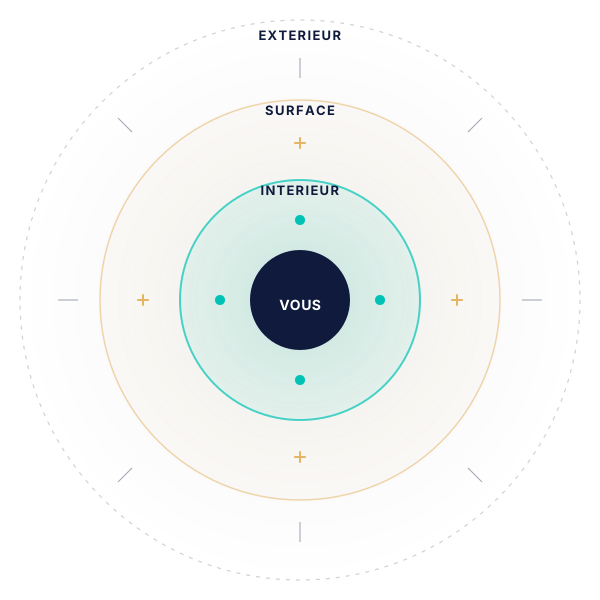
Audit of M365 or Google Workspace configuration, access management, MFA, data classification, backups, hardening of endpoints and servers, incident response plan. Security starts with what you already control but often have misconfigured.
Inventory of exposed assets (sites, subdomains, services, certificates), penetration tests on the most critical applications, ongoing security patch verification. We see your organisation the way an attacker sees it, and close the doors one by one.
24/7 Dark Web monitoring: leaked credentials of your employees, mentions of your brand on fraud forums, and especially registration of domains similar to yours set up for phishing or impersonation. The aim: to warn you before the attack is launched.
Tailored to your actual risk. Full mandate or only the layers you're missing, in support of an internal CISO for example.
Six ongoing tracks, sized to your organisation and exposure.
Drafting and upkeep of your security policy, IT charter, AI usage charter. Regular security committee with leadership, written minutes, decision tracking.
Mapping of your critical data and systems, threat identification, protection assessment, prioritised action plan based on actual risk, not an abstract checklist.
Annual review of protections. Targeted penetration tests on your most exposed applications (website, customer portal, mobile apps). Costed action plan and re-check after fixes.
Inventory of your critical vendors (cloud, payroll, hosting, IT support). Contractual review of security clauses, exit plan if things go wrong, yearly tracking of commitments.
Identification of activities that cannot stop, documented recovery plan, scripted annual exercise (cyberattack, vendor loss, prolonged outage).
Short sessions for leadership (personal liability), practical training for teams (phishing, passwords, sensitive data), access to our e-learning platform if you wish.
You need an identified security officer, documented governance and on-time incident reporting. We take ownership of the mandate, you stay compliant.
Your clients, your bank or your insurers still ask for a credible security framework. Or you simply want to sleep easy. We build what's useful, without piling on useless paperwork.
Increasingly required in tenders. Our CISO drives compliance, prepares the audit, supports you during the visit and runs the yearly upkeep.
Without a prior mandate. We can step in on a one-off basis to qualify, contain, notify authorities if needed and prepare the post-mortem, with no obligation to keep us afterwards.
NIS 2: administrative fines with a maximum of at least €10M or 2% of total worldwide annual turnover for essential entities, €7M or 1.4% for important entities, whichever is higher (Article 34). Management bodies can be held liable for infringements (Article 20).
DORA: penalties for financial entities are laid down by each Member State and imposed by the competent authorities, including the CSSF (Article 50). Critical ICT third-party service providers also face a daily periodic penalty payment of up to 1% of their average daily worldwide turnover, for no more than six months (Article 35).
Outside NIS 2 and DORA, the GDPR always requires security measures appropriate to the risk for personal data (Article 32).
A chief information security officer who is not on your payroll: you appoint them by contract, and they run security as a business function. Security policy, risk management, oversight of technical measures, incident handling, a security committee with management. At Luxgap the role is backed by a team of cybersecurity engineers and lawyers. The mandate formats are set out on our external CISO and CISO in Luxembourg pages.
Directive (EU) 2022/2555 does not prescribe a job title. It requires cybersecurity risk-management measures (Article 21) and makes them the business of management bodies, which approve them, oversee their implementation, can be held liable for infringements and must follow training (Article 20). Significant incidents are reported to the CSIRT or the competent authority: an early warning within 24 hours, an incident notification within 72 hours, a final report no later than one month after that notification (Article 23). Someone has to run this day to day: that is the CISO's job, in-house or outsourced.
Regulation (EU) 2022/2554 gives the management body ultimate responsibility for managing ICT risk (Article 5). Financial entities other than microenterprises assign the management and oversight of that risk to a control function with an appropriate level of independence (Article 6(4)). They may outsource the verification of compliance with these requirements, in accordance with Union and national sectoral law, while remaining fully responsible for that verification (Article 6(10)). An outsourced CISO therefore works for the management body, which keeps the decisions. They also organise ICT third-party risk management, including the register of information and exit strategies (Article 28).
No. The GDPR always requires security measures appropriate to the risk for personal data (Article 32), and your clients, your bank or your insurers often expect a credible security framework. The mandate is then sized to your organisation and your real risk, without piling up paperwork.
They qualify the incident, coordinate containment, prepare the notifications and run the post-mortem. Deadlines depend on the law: in principle 72 hours to notify a personal data breach to the CNPD (GDPR, Article 33), an early warning within 24 hours for a significant incident (NIS 2, Article 23), successive notifications and reports to the competent authority for a major ICT-related incident, the CSSF for the financial sector (DORA, Article 19). Without a prior mandate, we can also step in on a one-off basis.
It depends on the scope: number of sites and staff, applicable laws, starting maturity, expected on-site presence. You configure the quote online and receive a tailored proposal within one business day.
You have a legal obligation: we take ownership of it. No staff augmentation, no man-days package, no minimum. We commit to the outcome, and behind your single contact, there is a full team.
You're not paying for days worked. We sign to keep your obligation met, records, DPIAs, NIS 2 governance, regulator reporting. If that means three exchanges in a week, we do them.
You have a single point of contact. Behind it: lawyers (GDPR, AI Act, NIS 2, DORA), cyber engineers (audits, technical DPIAs, BCP, incidents) and developers (in-house register/DPIA tools, AI automation agents). The right profile steps in at the right time.
Even a mandate sized for one day per month yields multiple short interventions: a 30-minute call, a written reply, an ad-hoc DPIA, a steering committee. We answer, we step in, we don't vanish between invoices.
Every action is logged. One hour on Teams = one hour billed, nothing more. No half-day minimum, no hidden bundle. You pay what we use, and only that.
You access a detailed log: who did what, when, on which topic, for how long. In case of a CNPD, ILR or CSSF inspection, that journal is proof of an actively operated mandate, not just a contract on paper.
Our mandates range from 12-person SMBs to 800+ industrial groups, including public bodies, municipalities and institutions. Our method scales to your size, not the other way round.
Configure your quote, you receive a tailored proposal within one business day.
Build my quote →